Rechenka’s Eggs

TITLE: Rechenka’s Eggs
AUTHOR & ILLUSTRATOR: Patricia POLACCO
PUBLIHSER: Philomel Books
AGE GROUP: 4-8 years.

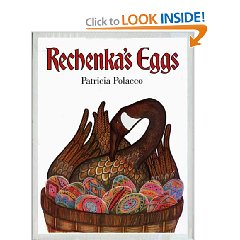
While Patricia Polacco needs no introduction to those of you who have been enjoying her stories, rest of you book lovers deserve to experience the warmth that her books generously ooze out. And that is why I chose Rechenka’s Eggs.

From my Russian background my stories are kind of ethnic, primitive, Eastern European — that’s one type of voice I write in, says Patricia. Set in Moskva in pre-revolutionary Russia, that is exactly the voice we hear in this book.

Babushka (Russian for grandmother) is a kind hearted old woman who spends the cold and dark winter days painting eggshells in her country home. She has a reputation for her beautifully designed eggs and she plans on taking them to a contest for the Spring Festival in the city. On a snowy day that winter, even as she is greeting a herd of caribous outside of her home, an injured goose separates from its flock and falls on her lap. The good Samaritan Babushka is, heals the goose and gives it a cozy corner in her own home. Babushka lovingly names her Rechenka and the bird lays an egg for her every morning. Thus a friendship is born.

However, an accident that ends the serenity and goodness that we have gotten used to so far, also leads to a chain of magical events. A clumsy Rechenka overturns paint jars and even breaks Babushka’s gorgeous eggs. Babushka is upset. But the next morning, her usual breakfast egg from the goose is not an ordinary one, but an exquisitely painted one! A dozen more follow. “A miracle”,thrilled, Babushka whispers. It is soon spring, time for the festival. Also, the time for Rechenka to move on and migrate with her clan. Time for adieu. Babushka leaves for the city with her (Rechenka’s) eggs. The eggs win her accolades. Back home, curled up loney with her book in bed, Babushka hears something. Following it, she finds a glorious egg left in the basket Rechenka rested. But this one moves….jumps..rolls…and there lies Rechenka’s special gift!!!

The reader swallows a lump in the throat. A sigh. Beautiful does not describe it. And I am not saying it just for the story but for all those pictures that whisked us off to old Moscow. The Moskva women in ethnic attire, the onion-domed architecture, the eggshells – a dozen of them with intricate folkloric art, even the wrinkles and folds of skin on Babushka’s face and limbs, all do their bit in binding us to the story.

There is also this balance in the elements of reality and imagination – while the backdrop of wintry Moscow, the festival and the contest, the caribous and a warm-hearted Babushka ground the story, the painted eggs from the bird and the element of surprise impart a fairy-tale like magical quality that children will love. With her eye-catching illustrations, richness in flavor, lucid writing and a touching storyline, Patricia Polacco is truly a wonderful writer and artist. You need to read the book, to experience the joy!

Mrs.McCool And The Giant Cuhullin – An Irish Tale


TITLE: Mrs.McCool and the Giant Cuhullin
AUTHOR & ILLUSTRATOR: Jessica Souhami
PUBLISHER: Henry Holt and Company
AGES: Good for “Read Aloud” and “Read it Yourself”.

The joy of folktales is something that we recently discovered at our home. Stepping aside from classics and contemporary humor , we seem to embrace folktales, quite effortlessly. The book that I have with me is an Irish folklore, bearing a tale very similar to the ones that were orally passed on to me while I was growing up.

The central characters in this tale are legendary giants Cuhullin and Finn McCool. Mrs. Oona McCool is the one with the brains and quite intuitively, also the one to save her husband oftentimes from Cuhullin. Now, Cuhullin has a magic finger that makes him strong and Finn has a magic thumb that bestows upon him, the power to foresee things. Finn uses his magic thumb and announces (in jitters of course) the impending arrival of Cuhullin. Mrs.McCool to the rescue! A simple story you think, buckle up for a good dose of slapstick humor! Children will be laughing boisterously as they see fun illustrations and hear goofy dialogues.

Mrs.McCool is quick witted. She drops Finn with a bonnet in a cradle and welcomes Cuhullin for tea. She makes unreasonable, rather unrealistic (not that there is realism to worry here) requests that demand extreme brawn from Cuhullin. And this she does, so nonchalantly that Cuhullin is led to believe that the tasks are all a routine in the McCool household. Just look at the front cover – there is Cuhullin trying to lift the house so Oona can broom off the dust underneath! Here is also a sample of silliness to taste – “Goodness!” exclaimed Cuhullin. “Look at the size of him! Look at the moustache! If this is the baby, what must Finn be like?” , as Cuhullin mistakes Finn for a real baby. He also ends up sticking his finger in the “baby’s” mouth, only to have his magic finger bitten off! Petrified, the shrinking Cuhullin runs amok, leaving a cheery couple dancing!

It was nothing, dear Finn,” said Oona.”Big is Big. But brains are better!” . Probably the profound truth that this story intended to convey to little children and just as the message drives home, you are still not really far from the jocund moments. The magic of folktales it is. Loony and wacky, oh yeah! But did you also realize the feminist undercurrent, the portrayal of the woman endowed with brainpower, the one to thwart a giant – amazing to think of it when there is still so much gripe in contemporary children’s literature about the roles women or girls are given! Quick paced with bright collage like illustrations, this book is wonderful to be read aloud to children!

There is never enough said about folktales. Flavorful, informative and historic, with so much room for imagination. These hand me downs from wonderful storytellers, sometimes didactic and sometimes just for laughs. Timeless.

My Gandhi Scrapbook

I saw Google incorporate the face of Gandhi into their logo first thing this morning. I was reminded of this book. Her aunt had given it to her on her birthday. I pulled it out of my saved-for-later stash and turned to look at the back cover. For all ages it said. I flipped through to make a quick judgment of the content before I presented it to her. I smiled and beckoned my little one.

My Gandhi Scrapbook, compiled by Sandhya Rao at Tulika Publishers, India.

A very warm and casually written introductory note from Sandhya talked in simple terms about scrap booking and went on to encourage children to add to the collection in the book. We flipped and we saw Gandhi everywhere! I can’t help but verbalize a scrapbook here, now that I actually saw one, a well-made one. Photographs and images of currency and postal stamps bearing his visage were splattered all over. Tags, comments and labels floated near them with little details. She took her finger here..there. Mine followed hers. She then took the book closer to read finely printed letters on a vintage photo. Colorful art, monochromatic photographs and handwritten patches carried tidbits of his life, style and work.

Beyond the images of currency, were a bunch of thematically assembled photographs. All were sightings of places (streets, squares roads, parks) from around the world, carrying placards with his name. We turned the page, and saw more caricature. On this page, was a tip to create a quick Gandhi doodle. She giggled. But then came a spread of vintage black and white photographs of Mohandas, in his boyhood and adolescence (and of the bald old man we all love). Another couple of pages showed how omnipresent he is, even today. This was conveyed through images of magazine covers, child art and hoardings. Beside these were little bubbles loaded with bite-sized facts about the Mahatma. The neat bonus was a few sheets left blank for the child to collect more such wonderful scrap!

You get the idea now, I suppose. And so did my 5 year old. I watched her hold on to the book and gaze at the photographs even as I walked away thinking that every kid reading this book is sure to find him cool just as she did!
Digestibility. We all look for this attribute when it comes to presenting history, religion or mythology to our children. And this book takes good care of this.

Live simply that others may simply live – M.K.Gandhi. I pull this out from a yellow blob in this book, as we celebrate a hero’s birthday today!

Best Friends, for EARTH DAY


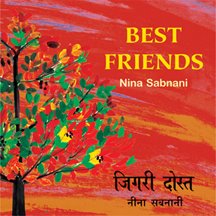
Its EARTH DAY today everyone! As always it calls for a celebration here at Saffron tree! And what better way to do it than through a good book? That is why I have here with me BEST FRIENDS, written by Nina Sabnani; a neat blingual production from Tulika Publishers, India. No contemplation preceded the choice of this book. And it cannot be more befitting for today – the celebration of a little girl’s friendship with a tree.

We are introduced to little Tamanna playing in the garden. We see her talking and sharing stories from her school and home to the big tall beautiful Kuchi. The sounds of nature had led her to believe, when she was a baby, that the tree actually spoke. Shhhuunnn! Muuuunnnn! was the language her companion spoke, she thought, and thus a friendship was born. However, her chatty friendship becomes a subject of ridicule and mockery amongst her human friends and that prods her to rethink her relationship. Pragmatism wins and her delusion ends.

Years roll by and we see her reading a book to her daughter. Shhhuunnn! Muuuunnnn! Something beckons her. Running out into the garden she sees a man with an axe. Stop! Don’t touch Kuchi! screams the woman, our Tamanna. The closing image is that of a little girl in a swing suspended from one of Kuchi’s branches. The friendship is passed on.

I turn the book and read “Based on a real friendship between Nina Sabnani’s niece and a tree….”. Deeply touched.

The author is also the illustrator. The text is oddly simple and the reasoning for this would be its ability to support multiple Indian languages. But the profound thoughts that the simple text can transmit impresses me. Trees, like water, symbolize our giving earth in its (her) full glory. Irrespective of whether we choose to talk about deforestation or recycling or about simply closing the pipe while brushing, amongst us and to our kids, the importance of our environment, the generosity of nature and the beauty of our home, the earth stands. Happy Earth Day!

AMADI’S SNOWMAN

Publisher: Tilbury House, Publishers, Maine, USA
Author: Katia Novet Saint-Lot
Illustrator: Dimitrea Tokunbo

What is a snowman doing on the front cover of a book bearing what I think looks like an African boy in a village setting? Little did I know that it was curiosity of this nature that was the basis for the transformation in young Amadi’s life, the central character in the book Amadi’s Snowman.

Amadi is a native of the Igbo tribe of Nigeria in Africa. The story is set in a hamlet in Nigeria, boasting marketplaces and friendly faces amidst which Amadi is raised by his hardworking mother.

What we come to understand after the introductory pages is Amadi’s impregnable resistance to learn to read. He strongly believes that the ability to read is unneeded for an Igbo boy whose stereotyped ambition is to grow up to be a business man. Wandering at the marketplace, Amadi chances upon his friend Chima furtively buried in a book. It is now that Amadi’s eyes fall upon an image of a boy bundled up in clothes next to a strange animal with a nose that looked like a carrot. Everywhere around, the ground and trees sparkled, blinding white. To some of us the image of a boy and a snowman could seem effortlessly digestible but to an Igbo man in Africa whose land is drenched in sun all through the year, this can sure seem hard to gulp. His ignorance is dispelled by Chima, who now seems to be the all-knowing idol to Amadi. But Chima soon takes off abandoning the book and poor Amadi who stands there with a whole lot of questions queued up in his head. This incident sows the seeds for Amadi’s genuine enthusiasm to read, to learn, and to discover.

Amadi’s quest does not end here. He begins to realize the existence of a lot more beyond his small world, like the snow and snowman. But they are all going to be out of reach if he did not know to read. The climax is when Amadi finds the same book in his house, gifted to him by Mrs. Chikodili, his tutor whom he is seen avoiding all through. You can tell Mrs.Chikodili I’ll learn how to read are Amadi’s final words in the book.

The depiction of the life of a rural African boy can itself be intriguing to urban children. The rustic scenes painted in warm earth tones come as a bonus, thanks to Dimitrea Tokunbo. The book is also overly apt for Saffron Tree for more than one reason – not only is it truly multicultural as in being a story about a tribal boy in Africa and created by a well-traveled author who now lives in India, but it is also one that spoons children the motivation to learn to read.

The initial resistance to read that Amadi exudes is probably a feeling that all young children might be able to relate to and the fact that the story can eventually inspire them to read is the most wonderful and powerful thing about this book! Nothing says this like when my 4 year old worriedly and hurriedly ensured “Ma, I know to read, right? I will know to read much better on my own, right?” as I slowly closed the book.Thumbs up to Katia Novet for this neat package! Literacy is a heavy subject and to translate it to young children is a daunting task. But looks like Katia Novet has effortlessly and wonderfully accomplished this endeavour.

Today is International Day of Non-violence…

MARCHING TO FREEDOM
Author: Subhadra Sen Gupta
Illustrator: Tapas Guha
Publisher: Pratham Books, India

Age Group: 11-14 years

For today’s children Gandhi is just a face on our currency note or a picture in a dull history book. But what he stood for is something that I feel all children should value —tolerance and non-violence. – Subhadra Sen Gupta

Ample reason to write a book on Mahatma Gandhi for children. And today seems adequate enough to review this book from Pratham Books.

The setting is the Sabarmati Ashram in the western state of Gujarat in India, which Gandhi and his followers called home during the Freedom Struggle in India. Dhani is a 9 year old boy being raised in the ashram by his Gandhian parents. Dhani also seems to be responsible for taking care of Binni, the goat, who is his incessant companion and whose milk seems to be a part of Gandhi’s morning diet.

Dhani is portrayed as a cheery little boy skipping around the ashram premises, inquisitive, eager to know, and quizzical. Dhani senses a plan brewing in the ashram and the tale kicks off with his attempts to find out more about it. Persistent as he is, Dhani learns from his mother of a march near the sea and learns a lot more from Bindha, also a resident working in the garden. Bindha neatly lays out the details and discloses Gandhi’s idea of walking across Gujarat with his men, to a coastal place called Dandi to make salt.

It is but natural for Dhani to innocently clarify “Why will they make salt? You can buy it in every shop! Walking for a month! Why don’t they take a bus or train to Dandi instead?” Questions that children might echo.This is when Binda explains the salt tax and the restraint to make sea salt imposed by the British, and the purpose of the march as a form of non-violent protest.

Impressed by Gandhi’s ideas and motivated by the unfairness of the issue, Dhani is eager to participate, eager enough to follow Gandhi during his morning walk the next day to get his permission to join him. The simple yet well-chosen explanation that Gandhi adopts in order to convince Dhani to happily stay home completes the fiction.

The two pages of simple facts on the Dandi March of 1930 that flagged off the Non Cooperation Movement in India probably makes the book appropriate for the 11-14 years age group as the book claims. The book itself was written to commemorate the 75th anniversary of the event.

I talk a lot to children in schools and I found that though they like historical fiction, they dislike history!, shares the author who bears a reputation for creating historical fiction. Her resume includes a list of well-known publishers, and same is the case with the illustrator Tapas Guha. The sugar coated presentation of a piece of Indian history that teaches non-violence undoubtedly deserves our appreciation. This book also seems to be a part of a series called “Once upon an India”.

I seem to be stumbling upon books on Mahatma Gandhi lately, and I think this post will be a befitting place to add pointers to them for it may help parents around the world to introduce to children the ideas of non-violence and tolerance. And needless to say, a great leader such as Mahatma Gandhi.

A man called Bapu also from Pratham Books
Picture Gandhi – Tulika Publishers

AND My Gandhi Scrapbook – Tulika Publishers, both available here

MINJI’S SALON


AUTHOR & ILLUSTRATOR: Eun-hee Choung
AGE GRP: 3-5 yrs
SPANISH language edition also available

“An ode to the power of children’s imaginations (and their parents’ patience), Minji’s Salon reminds readers that creativity and play are worldwide phenomena.”
is what the publisher Kane Miller rightly claims.

Yet another book on pretend-playing and dress-up that I got my hands on, but the overdose doesn’t seem to tire my 4 year old girl!

A simple story line. Mother visits the local salon for a vivid red color and a fancy haircut. Daughter creates a make-believe salon at home assuming the role of the stylist. The guinea pig is her dog companion at home. Smell chaos already? Wait until you see what Minji is up to.

Something really neat in the book is the juxtaposition of equivalent scenes, the city salon on one side and Minji’s home base on the other. This presentation makes it easy for the child to get a grasp of the hilarious on goings in parallel. While the rendezvous of the mom with her stylist progresses on the left, Minji’s date with her canine friend evolves on the right. Similar drill, dialogues and drama. An ice-cream concoction for color, crayons for holding the fuzz, generous use of water colors – all to simulate the hairdresser’s paraphernalia and perform the shear act on her own specimen. Can you imagine the predicament of the dog? Visuals just enough to make the little reader giggle or guffaw.

Another observation would be the fact that mom’s proceedings happen in a confined rectangular window while Minji’s play has no defined boundaries (on the pages), clearly portraying how a child’s imagination has no bounds, whatsoever! And this is the central idea of the book.

Mom is back, pretty and perky. Her initial shock softens into surprise and then a sweet tolerance takes over even as she stands there encompassed in total mess. A feeling that mothers all around the world can comfortably relate to.

“ My goodness! Are you the owner of the salon?”
“Yes Madam. Would you like to make an appointment?”

We see no end to Minji’s frolic. However the book comes to an end with a picture of Minji staring at a mannequin through the glass window of a city store, not to forget the bright red oversized stilettos she has gotten herself into!

Eun-hee Choung lives in South Korea, academically qualified in art and illustration. And I can safely conclude that she has done adequate justice to the above fact in Minji’s salon where visuals dominate text.

MY FRIEND JAMAL


STORY & PHOTOGRAPHY: ANNA MCQUINN
ARTWORK: BEN FREY
AGE GRP: 4-7 YRS.

The book is a boy’s narration of his culturally diverse yet completely uncomplicated friendship with another boy his age. In other words it is a celebration of an unadulterated friendship that oversteps borders, religion and culture.

Our little narrator, Joseph, introduces to us readers, his friend Jamal of Somali origin, however, born in the same hospital as him, the same month! After sharing with us the staples of their friendship built on activities and interests that are typical to boys their age, Joseph lets us into more unexpected specifics. This includes Jamal being a Muslim, Jamal’s dietary restrictions (both cultural and health-related) and an analysis of Jamal’s household – how pasta is served with banana toppings and how his family dines on the floor, more like a picnic! In fact, something that, in my opinion, felt very real and down-to-earth were these lines –

Sometimes I go to Jamal’s house.
It smells different from ours because his mom cooks with special spices.

Isn’t it true that something as simple and different as this can actually be acknowledged and reasoned out by the innocent mind? And books that carry such thoughts, I believe, can provoke and aid open healthy discussions of complex issues of the real world with a growing child.

Marching on, the pages are filled with fun and precious details of their likes and dislikes, commonalities and differences, – about superhero games, basketball teams and automobile preferences, all sure to score a three-pointer with any male child! Joseph then narrates more about the prayer routine he witnesses at Jamal’s, the Koran in Arabic that his friend talks about and the war and fighting in Somalia from which the family fled. What catches the reader’s attention is the non-judgmental and intrigued tone with which the small boy speaks. In fact, everything that revolves around Jamal with whom Joseph shares his life is probably diametrically in contrast to his own settled Christian life and yet he nonchalantly accepts Jamal and his family.

This book can be an ideal pick for discussing cross-cultural friendships with children. The details though raw are real and gentle. The author Anna McQuinn was raised in Ireland and now lives in England adding titles like Lola at the library and Wanda’s washing machine to her credit. The illustrations are a combination of photography and art – bold, colorful and explicit, just as the front cover indicates.

A wonderful work that showcases how children adjust and adapt to strikingly contrasting cultural canvases while holding on to their own individualistic identities, something that nature and puerility seem to take care of.

MY CAT COPIES ME

MY CAT COPIES ME
Author and Illustrator: Yoon-duck Kwon
Age group: 4-8 years

This is one of those books in which the illustrations carry more weight than the text itself. The package might seem simple, superficially, but shrouded underneath are deeper messages that are crucial for growing children. Another significant attraction would be the fact that it can be a wonderful treat for cat lovers and cat loving or pet loving children! Let me move on and embark on the task of peeling off the layers of the charming tale, from my own perspective and based on some research that I did.

The book opens up with an introductory note about the cat and the relationship the girl bears with the animal. In the girl’s opinion, her cat is mostly independent except, when ignored, when she actually tries to imitate her!. The skin-deep impression is that of a girl declaring how her shy cat ends up copying her a lot. Snapshots of the cat and the girl entertaining themselves in merriment are what follow. We see the girl and her pet hiding behind newspapers, furniture and clothes, chasing flies and watching bugs.

But going beyond and reading between the lines leads us into some dry humor, the subtle fact that the cat is actually doing what cats very typically do! This leaves us with the feeling that a lonely girl is actually seeking consolation in the company of her cat.

Midway, the tables turn – “But from now on… … I will copy my cat!”

“Like my cat, I’ll look outside.
I’ll watch the darkness, and I won’t be afraid.”

In the ensuing pages are illustrations of the girl and her feline friend climbing high (as seen on the cover page, which all makes sense now) stretching their bodies in unison, fearlessly stepping “out” and making new friends. The positivity in the chosen actions are undeniable and sets the stage for the transition in the girl’s persona.

And now is when the message begins to crystallize – an introverted girl has actually turned to her cat friend to face her fears and face the world. The closing image is that of the girl playing with her new friends, other neighborhood children, along with her cat! Not beating around the bush, a timid child will probably be able to relate to the girl and more importantly learn to lean on something and break free.

The grey outlining to vibrant images adds interest. Another subtlety is the intentional dark background on the few pages when the girl actually sheds her fears and opens up. The backdrop is a Korean household and neighborhood, imparting the Asian feel to the book. A background check on the author revealed the artistic credentials she bears in brushwork painting, Asian landscape painting and Buddhist paintings. A rather mild drawback in my opinion would be the lack of stronger, firmer or more substantial text to convey the very significant and wonderful message the book carries. While the simplicity of the surface reading is to be appreciated the lack of depth in the text to corroborate the illustrations and hence the message can be a tad unsatisfying. However, the demystifying process seems very satisfying!

For the Lunar New Year – New Clothes for New Year’s Day


NEW CLOTHES FOR NEW YEAR’S DAY
By Hyun – Joo Bae
Age: 4-8 years

This book is a celebration of the Korean culture and heritage, more specifically of the Korean Lunar New Year. I could say that or I could just say – it is a book about a little girl playing dress-up, Korean dress-up. Take it as you wish, but its a cheery book that every little girl will savor!

In her plain white underclothes stands the little girl looking out the window on a cold winter morning. But its the first cold winter morning of a New Year! And what brings the most joy to her little world is her new crimson silk skirt and her chance to bask in it. The narrator demonstrates how carefully and delicately she adorns herself. She puts on her skirt, her embroidered socks, her rainbow jacket, her delicate headgear and a long list of fine accessories. But the subtle yet strong nuances are what make it so wonderful – the pause to admire at every stage, the crusade to tie the perfect bow, the minor adjustments to make it look just right. More embellishments – new, textured, intricate, dazzling. Down to the finest detail, a charm for luck! Just as fresh snow makes a landing, the girl is all ready, so utterly perfect to set out to wish good luck to her near and dear.

With a straightforward and very simple way to introduce Korean traditions to children, the book is laden with the inherent serenity that the far east emanates. Elegant, warm and colorful sketches seem to do justice to the girl’s ulterior desire. The last two pages of the book are dedicated for factual content – a write up on traditional Korean (Lunar) New Year celebrations and the significance of new clothes for New Year’s. Alongside is a diagram of the ensemble, head to toe.

A sleepless night on the eve of a chance to wear a new attire is not uncommon in a child’s world. This book neatly lays it out, drenched in an Asian flavor, while exhuming warmth and cheer. Don’t chide me for your little boy’s nonchalance for the book but it sure is a guaranteed delight for any girl, anywhere on the map!